The Longing to Feel Intensely Again in Mandarin Chinese
It's 2022, and the high-tech era is well underway. These days, speakers of about every language on earth have adult their own systems of Internet shorthand that help them express thoughts and feelings efficiently. The world of Chinese Internet slang, of course, is no exception.
In lodge to keep your Mandarin skills fresh, it'south of import to familiarize yourself with Chinese Internet slang. In this article, we'll dive into some of 2022's about usually used Mandarin cyberspeak.

Tabular array of Contents
- Why larn Chinese Internet slang?
- Half-dozen popular online acronyms to learn today
- ane. yyds (永远的神)
- 2. nsdd (你说得对)
- 3. zqsg (真情实感)
- four. xswl (笑死我了)
- 5. plgg (漂亮哥哥), pljj (漂亮姐姐)
- 6. bdjw (不懂就问)
- Three Chinese slang terms you need to know
- 1. 内卷 (nèijuǎn)
- ii. 躺平 (tǎng píng)
- iii. 破防了 (pò fáng le)
- Keepin' it fresh
- Internet slang vocabulary
Why learn Chinese Internet slang?
Even the most avant-garde linguistic communication students may find themselves mystified past the chop-chop evolving world of Chinese Internet slang.
While y'all may have heard of mutual online terms like 666 (liùliùliù; crawly) or 88 (bābā; bye-bye), modern Chinese Internet slang also includes an extensive list of usually used alphabetic acronyms. These acronyms are just abbreviations based on how sure groups of Chinese characters are written in pinyin .
Although these Net acronyms are frequently used past Chinese netizens, they aren't well known amidst language students. In order to communicate effectively with Chinese people on social media , comprehend Chinese language digital media and keep your Mandarin skills up-to-date, information technology's important to understand mutual online phrases as coined by the mainland'southward Cyberspace-savvy population.

Learning the newest Chinese Net slang will help keep your Standard mandarin linguistic communication skills up-to-appointment.
Six popular online acronyms to learn today
Ready to requite your Chinese skills a modern makeover? Stay hip to the civilization by mastering these half dozen popular Chinese Net slang acronyms today.
1. yyds (永远的神)
永远的神 (yǒngyuǎn de shén; yyds) means "eternal God" and describes an outstanding person or affair. It's similar to the saying GOAT (Greatest of All Time) in English language. The phrase is often used by fans to praise their idols or simply to describe something they are fond of.
For example:
- 桂林米粉太好吃了,桂林米粉就是yyds!
- Guìlín mǐfěn tài hàochī le, Guìlín mǐfěn jiùshì yyds.
- Guilin rice noodles are succulent, they're but yyds!
Here's another example:
- 李小龙的中国功夫太厉害了,他就是yyds!
- Lǐxiǎolóng de Zhōngguó gōngfū tài lìhài le, tā jiùshì yyds
- Bruce Li's kung fu skills are so expert, he's such a yyds!
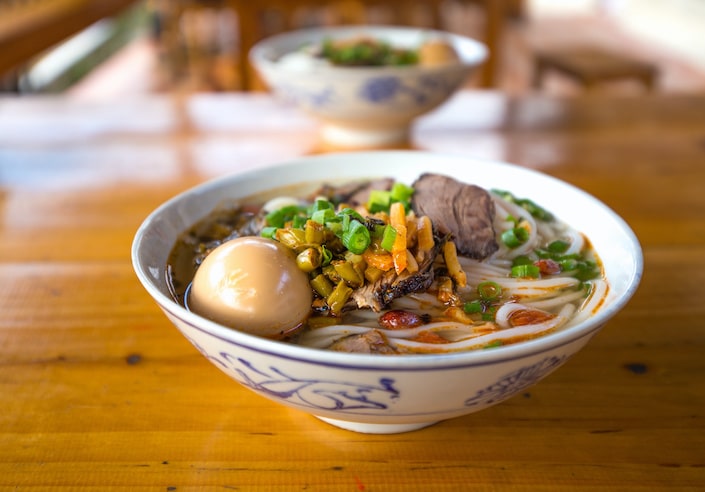
Yyds is the perfect phrase to describe the delicious sense of taste of Guilin'due south most famous dish: Guilin rice noodles!
ii. nsdd (你说得对)
你说得对 (nǐ shuō dé duì; nsdd) means "what you said is correct" and is mostly used to endorse or approve of what someone has said.
For example:
- Nsdd!这样的做法是正确的。
- Nsdd! Zhèyàng de zuòfǎ shì zhèngquè de.
- Nsdd! That's the right way to do it.
Yet, it tin can also exist used to brush someone off past hastily agreeing with them if the speaker doesn't wish to continue the chat. For case:
- Nsdd, 都听你的。
- Nsdd, dōu tīng nǐ de.
- Nsdd, any y'all say.

Nsdd can accept a positive or negative meaning depending on the context in which information technology is used.
3. zqsg (真情实感)
真情实感 (zhēnqíng shígǎn; zqsg), which translates as "truthful feelings," describes an emotionally touching or heartfelt state of affairs and is generally used to annotate on movies or TV dramas.
For example:
- 《你好,李焕英》这部电影太zqsg了!
- "Nǐhǎo, Lǐ Huànyīng" zhè bù diànyǐng tài zqsg le!
- The movie "Hullo, Li Huanying" is and then zqsg!
Another example:
- 很久没有看到这么zqsg的军旅剧了。
- Hěn jiǔ méiyǒu kàndào zhème zqsg de jūnlǚjù le.
- I oasis't seen such a zqsg war motion picture in a long time.
$10.00 
Adjacent fourth dimension you're traveling or only chattin' in Chinese with your friends, driblet the textbook formality and bosom out with expressions they never teach yous in school, including: cool slang, funny insults, explicit terms, everyday banter.
Purchase from Amazon
We earn a commission if you make a purchase, at no additional cost to you. 11/xvi/2021 22:45 pm EST.

four. xswl (笑死我了)
"笑死我了" (xiào sǐ wǒ le; xswl) literally ways "laughing to death" and is used by speakers to answer to something funny, comparable to LOL in English.
For instance:
- 这张图片好搞笑, xswl!
- Zhè zhāng túpiàn hǎo gǎoxiào, xswl!
- This photo is and so funny, xswl!
For another example:
- Xswl,怎么会有这么搞笑的视频?
- Xswl, zěnme huì yǒu zhème gǎoxiào de shìpín?
- Xswl, why is this video so hilarious?

Xswl is the Chinese equivalent of LOL.
five. plgg (漂亮哥哥), pljj (漂亮姐姐)
漂亮哥哥 (piàoliang gēgē; plgg; used for men) and 漂亮姐姐 (piàoliang jiějiě; pljj; used for women) can be translated every bit "pretty brother" and "pretty sis," respectively. Chinese netizens generally apply these phrases to compliment someone's expert looks. Keep in heed, however, that "plgg" is typically used to describe stereotypically feminine men.
For example:
- 哇!这真是个 plgg / pljj 。
- Wa! Zhè zhēnshi gè plgg/ pljj.
- Wow, this plgg/pljj is really attractive.
These terms can besides exist used every bit a polite form of address for someone the speaker doesn't know well. For example:
- Plgg / pljj,请问这个是什么?
- Plgg / pljj, qǐngwèn, zhège shì shénme?
- Plgg / pljj, may I ask what this is?

Plgg or pljj tin can be used as a polite, if informal, form of accost.
6. bdjw (不懂就问)
不懂就问 (bù dǒng jiù wèn, bdjw) is a helpful transition phrase used to innovate a question. Information technology is like to "just wondering" or "let me ask" in English.
For example:
- Bdjw,什么是阿基米德定律?
- Bdjw, shénme shì Ājīmǐdé dìnglǜ?
- Bdjw, what is Archimedes' police?
Here's some other example:
- Bdjw,这是什么奇怪的东西?
- Bdjw, zhè shì shénme qíguài de dōngxī?
- Bdjw, what'southward this weird thing?

Chinese netizens utilize the acronym bdjw to introduce a question they're about to ask.
Iii Chinese slang terms you need to know
In add-on to pinyin-based acronyms, modern Chinese also contains a wealth of new slang terms. Unfortunately, the meanings of these terms are often unclear to those who aren't in the know. Check out our list of iii of the major Chinese slang terms that are trending right now.
1. 内卷 (nèijuǎn)
Slang Utilize
内卷 (nèijuǎn) has come to describe—and oft express disgust virtually—the fiercely competitive temper that pervades everything from didactics to the workplace.
Example
You're sitting in a theater watching a theater functioning.
Out of the bluish, the guy in front of you stands up.
At present, yous're no longer watching trained actors charismatically performing on phase. Instead, you lot're gazing into the leering optics of the Nirvana smiley confront on the back of this guy's t-shirt. With an eye scroll and a sigh of frustration, yous ascension to your feet.
You lot hear a grunt of disgust as the person backside you lot now too shuffles to a standing position. You peer into the darkness effectually yous.
The consequences are cascading, as is the disgruntlement. Ane by one, each audience fellow member is forced up so as to encounter over the person in front end of them. Inside one infinitesimal, everybody's standing, less comfortable, and a bit agitated.
Everybody is competing for a good view, still everyone is worse off!
Additional Insight
内卷 (nèijuǎn) originated every bit a technical term in anthropology to describe "diminishing returns." It described a state of affairs in which an increment in population was not accompanied by an increase in innovation or productivity.
The term recently leapt out of the ivory belfry and into every corner of Chinese Internet culture. These days, 内卷 (nèijuǎn) has come to draw (and often express cloy nigh) the fiercely competitive temper that pervades everything from teaching to the workplace.
The term 内卷 (nèijuǎn) has come to be a rallying cry for Red china'south beleaguered millennials, many of whom are sick, tired, and burnt out from quite literally working or studying from 9 in the morning time until ix at nighttime, vi days a week. This is known as China's infamous "996 work culture."
Using the term 内卷 (nèijuǎn) is about more than just wringing one'southward hands at the land of society, however. Instead, the chat effectually 内卷 (nèijuǎn) is making a subtler point by highlighting the fact that the cutthroat competition that 内卷 (nèijuǎn) describes is both brutal and senseless.
In the opinion of many of the Chinese netizens who take latched onto this term and contributed to its soaring popularity, the mounting competitiveness of the concluding decade hasn't led to the miraculous gains in economic efficiency seen in the 80's and xc'due south. It also hasn't contributed to higher levels of literacy amidst eye schoolers.
Instead, everybody is just stressed out and their legs hurt from continuing in the motion-picture show theater for no reason.

The term 内卷 (nèijuǎn) is used to criticize the pointless nature of Mainland china'due south rat race.
Dictionary definition
Involution; curling in. Contemporary usage originating in the academic piece of work of anthropologist Clifford Geertz: "Agronomical Involution: The Processes of Ecological Change in Indonesia"
Modern-employ English language equivalent
The grind; the rat race; canis familiaris consume domestic dog world; survival-of-the-fittest
2. 躺平 (tǎng píng)
Slang Utilize
What do you exercise later peering through the looking drinking glass and recognizing the true nature of China's 内卷 (nèijuǎn) rat race?
Quit spinning that hamster cycle.
Quit running altogether.
In brusk, 躺平 (tǎng píng): just prevarication down apartment.
Yup, prevarication down flat on the ground and 休息一下 (xiūxí yīxià; accept a rest). Accept it easy, take a nap, take a break, have a day off from work, or, amend yet, take two. I mean, why are you lot number crunching for that Blackness Mirror tech company anyway? Didn't your buddy say that the teahouse in the park past his house was hiring a director?
Picture it: bamboo chairs, former folks playing Chinese chess, songbirds flitting through the copse, steaming cups of tea… doesn't that sound nice? Sure, the pay won't be a quarter as good, but money can't purchase happiness. Nosotros're talking near quality of life here. This is the spirit of 躺平 (tǎng píng).
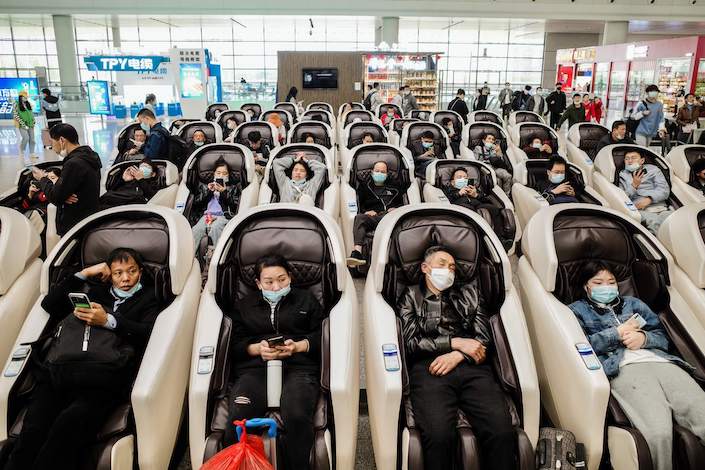
Tang ping (躺平 tǎng píng) is a lifestyle and social protestation movement in China that emerged around April 2021. It is a response to and rejection of societal pressures to overwork (for example, rejection of the then-called 996 organisation).
Boosted insight
The current popularity of "lying flat" is connected with and in some ways a response to the problem of 内卷 (nèijuǎn). However, not everybody is a fan of this newfangled notion.
躺平 (tǎng píng) has attracted the ire of both older generations (" Avocado-on-rice eating millennials! When I was your age in that location wasn't even such a thing as a midday tiffin pause! ") and government officials ( "The motherland is not developed enough to have the youth checking out of the workforce. Pull up your socks and fill out those Excel sheets!" ).
While the 躺平 (tǎng píng) lifestyle is not for everyone, so long equally Communist china'due south rat race continues to oestrus up, the 躺平 (tǎng píng) option seems destined to proceed to be seen as an bonny pick past many.
Dictionary definition
"Lying apartment;" taking it piece of cake.
Mod-employ English equivalent
While there's no direct equivalent, "quitting the rat race" comes close.
3. 破防了 (pò fáng le)
Slang Use
Today, 破防了 (pò fáng le) expresses being emotional overwhelmed. It is often used in social media comments under moving, heartbreaking, inspiring, or otherwise compelling articles, images and videos.
Additional insight
Emerging originally from the world of gamers, the phrase 破防了(pò fáng le) was initially used in the context of i's virtual city being overwhelmed past the invading forces of the enemy:
"Bro! The defenses are down! They're coming in! 破防了 (Pò fáng le)!破防了 (Pò fáng le)!"
In other words, "Our defenses have been breached! Nosotros're compromised!"
Every bit oftentimes happens, the Net snatched this phrase, retained some limited, context-specific aspects of its original meaning, and inflated it.
It is no longer your in-game metropolis walls that accept been overrun, but rather your psychological defenses.
Indeed, this phrase is so pop that the major Chinese video streaming site Bilibili selected 破防了 (pò fáng le) every bit their "comment of the yr."

Netizens use the term 破防了 (Pò fáng le) to describe an intense emotional reaction.
Dictionary definition
The defenses are downwards; the enemy has cleaved through
Modern-utilise English language equivalent
"This is too much"; "I just tin't!"
Keepin' it fresh
Congrats! Y'all're officially upward to speed on some of 2022's hottest Chinese Internet slang.
To employ your new cyberspace-friendly vocabulary, try engaging with Chinese people online past dropping a comment on a Chinese video or typing out 1 of these phrases during a WeChat conversation — native speakers volition exist amazed past your actuality and cultural awareness.
Think, if you lot're looking for more opportunities to exam out your language skills, studying in China is the premier path to fluency. If you tin can't travel to China correct now, CLI'southward online lessons provide an ideal way to build and refine your Mandarin abilities from the comfort of your own home.
Whatever yous do, make sure to continue incorporating some fun and fresh lingo into your study routine—you'll become a Chinese language "yyds" before yous know it!

Learning Chinese Internet slang is a nifty way to connect with members of China's younger generation on their ain terms.
Cyberspace slang vocabulary
| Hànzì | Pīnyīn | Definition |
|---|---|---|
| 永远的神 | yǒngyuǎn de shén | yyds; eternal god |
| 你说得对 | nǐ shuō dé duì | nsdd; you're right |
| 真情实感 | zhēnqíng shígǎn | zqsg; heartfelt and emotional |
| 笑死我了 | xiào sǐ wǒ le | xswl; hilarious |
| 漂亮哥哥 | piàoliang gēgē | plgg; a pretty male child |
| 漂亮姐姐 | piàoliang jiějiě | pljj; a pretty daughter |
| 不懂就问 | bù dǒng jiù wèn | bdjw; just asking |
| 网络 | wǎngluò | cyberspace |
| 俚语 | lǐyǔ | slang |
| 网络用语 | wǎngluò yòngyǔ | Internet slang |
| 流行词 | liúxíng cí | popular phrases |
| 上网 | shàngwǎng | to surf the web |
| 直播 | zhíbō | live broadcast |
| 网友 | wǎngyǒu | internet user |
| 热搜 | rèsōu | popular search term |
| 评论 | pínglùn | to comment on a mail service |
| 点赞 | diǎnzàn | to "like" a post |
| 网红 | wǎnghóng | internet celebrity |
| 热帖 | rètiē | pop discussion thread |
| 网传 | wǎngchuán | to circulate online |
Source: https://studycli.org/learn-chinese/chinese-internet-slang/
0 Response to "The Longing to Feel Intensely Again in Mandarin Chinese"
Post a Comment