Is Buddha Born Again as Jesus

Analogies have been drawn betwixt Buddhism and Christianity, and Buddhism may accept influenced Christianity.[1] Buddhist missionaries were sent by Emperor Ashoka of India to Syria, Egypt and Greece offset in 250 BC and may have helped prepare for the ideals of Christ.[2] Others take noted the significant differences between the two religions beginning with monotheism's place at the core of Christianity, and Buddhism'south orientation towards nontheism (the lack of relevancy of the being of a creator deity) which runs counter to teachings about God in Christianity; and extending to the importance of grace in Christianity against the rejection of interference with karma in Theravada Buddhism, etc.[3] [4] [5]
Some early Christians were enlightened of Buddhism which was proficient in both the Greek and Roman Empires in the pre-Christian catamenia. The bulk of modern Christian scholarship has rejected whatsoever historical basis for the travels of Jesus to India or Tibet and has seen the attempts at parallel symbolism as cases of parallelomania which exaggerate resemblances.[six] [7] [8] [9] Notwithstanding, in the East, syncretism between Nestorian Christianity and Buddhism was widespread forth the Silk Road in Artifact and the Center Ages, and was peculiarly pronounced in the medieval Church of the East in Red china, as evidenced by the Jesus Sutras.[10]
Origins and early contacts [edit]
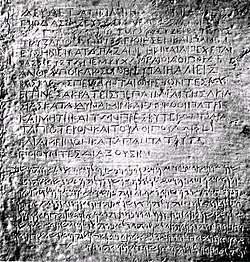

The history of Buddhism goes back to what is now Bodh Gaya, India almost six centuries before Christianity, making information technology one of the oldest religions notwithstanding existence practiced.[11] The origins of Christianity go back to Roman Judea in the early first century. The four approved gospels appointment from around 70–xc Advertising, the Pauline epistles having been written before them effectually 50–60 AD.
Starting in the 1930s, authors such as Will Durant suggested that Greco-Buddhist representatives of Ashoka the Bang-up who traveled to aboriginal Syria, Egypt and Hellenic republic may have helped fix the ground for Christian educational activity.[12] Buddhism was prominent in the eastern Greek world and became the official religion of the eastern Greek successor kingdoms to Alexander the Great's empire (Greco-Bactrian Kingdom (250 BC – 125 BC) and Indo-Greek Kingdom (180 BC – ten CE)). Several prominent Greek Buddhist missionaries are known (Mahadharmaraksita and Dharmaraksita) and the Indo-Greek male monarch Menander I converted to Buddhism, and is regarded as ane of the great patrons of Buddhism. (See Milinda Panha.) Some modernistic historians accept suggested that the pre-Christian monastic order in Egypt of the Therapeutae is possibly a deformation of the Pāli word "Theravāda",[xiii] a form of Buddhism, and the movement may have "almost entirely drawn (its) inspiration from the education and practices of Buddhist asceticism".[14] They may even accept been descendants of Asoka's emissaries to the W.[15]
Buddhist gravestones from the Ptolemaic menstruum have been found in Alexandria in Egypt decorated with depictions of the dharma wheel, showing that the Buddhists were living in Hellenistic Arab republic of egypt at the time Christianity began.[16] The presence of Buddhists in Alexandria has led one author to note: "It was later on in this very identify that some of the most active centers of Christianity were established."[14] Nevertheless, modern Christian scholars generally hold that there is no direct evidence of any influence of Buddhism on Christianity, and several scholarly theological works practice non support these suggestions.[17] [xviii] However, some historians such equally Jerry H. Bentley suggest that at that place is a real possibility that Buddhism influenced the early evolution of Christianity.[nineteen]
It is known that prominent early Christians were aware of Buddha and some Buddhist stories. Saint Jerome (fourth century CE) mentions the nascence of the Buddha, who he says "was built-in from the side of a virgin"; it has been suggested that this virgin birth legend of Buddhism influenced Christianity.[20] The early on church building father Clement of Alexandria (died 215 AD) was also aware of Buddha, writing in his Stromata (Bk I, Ch XV): "The Indian gymnosophists are also in the number, and the other barbarian philosophers. And of these there are ii classes, some of them called Sarmanæ and others Brahmins. And those of the Sarmanæ who are called 'Hylobii' neither inhabit cities, nor have roofs over them, only are clothed in the bark of trees, feed on basics, and drink water in their hands. Like those chosen Encratites in the nowadays twenty-four hours, they know not marriage nor begetting of children. Some, too, of the Indians obey the precepts of Buddha (Βούττα) whom, on account of his extraordinary sanctity, they have raised to divine honours."[21]
In the Middle Ages there was no trace of Buddhism in the West.[22] In the 13th century, international travelers, such every bit Giovanni de Pianoforte Carpini and William of Ruysbroeck, sent back reports of Buddhism to the Due west and noted some similarities with Nestorian Christian communities.[23] Indeed, syncretism in the East betwixt Nestorian Christianity and Buddhism existed along the Silk Road throughout Antiquity and the Center Ages, and was particularly pronounced in the medieval Church of the E in Prc, as evidenced by the Jesus Sutras.
When European Christians made more direct contact with Buddhism in the early 16th century, Catholic missionaries such every bit St. Francis Xavier sent back accounts of Buddhist practices.[23] With the inflow of Sanskrit studies in European universities in the tardily 18th century, and the subsequent availability of Buddhist texts, a word began of a proper encounter with Buddhism.[23] In time, Buddhism gathered Western followers and at the end of the 19th century the outset Westerners (due east.g. Sir Edwin Arnold and Henry Olcott) converted to Buddhism. In the start of the 20th century the first westerners (e.thou. Ananda Metteyya and Nyanatiloka) entered the Buddhist monastic life.[23]
Similarities and differences [edit]
Similarities [edit]
In the 19th century, some scholars began to perceive similarities between Buddhist and Christian practices, due east.thou. in 1878 T.W. Rhys Davids wrote that the primeval missionaries to Tibet observed that similarities have been seen since the first known contact.[24] In 1880 Ernest De Bunsen made similar observations in that with the exception of the death of Jesus on the cross, and of the Christian doctrine of atonement, the most aboriginal Buddhist records had similarities with the Christian traditions.[25]
Tardily in the 20th century, historian Jerry H. Bentley also wrote of similarities and stated that information technology is possible "that Buddhism influenced the early on development of Christianity" and suggested "attention to many parallels concerning the births, lives, doctrines, and deaths of the Buddha and Jesus".[19] Some high level Buddhists have fatigued analogies between Jesus and Buddhism, e.g. in 2001 the Dalai Lama stated that "Jesus Christ also lived previous lives", and added that "Then, y'all come across, he reached a loftier state, either as a Bodhisattva, or an aware person, through Buddhist practice or something like that."[26] Thich Nhat Hanh affirmed core Christian beliefs such as the trinity, and the decease and resurrection of Jesus Christ, in his volume Living Buddha, Living Christ. Bokin Kim, similarly, sees Christ every bit the Buddha Dharmakaya, and Jesus as similar to Gautama who was just a historical manifestation of the transhistorical Buddha.[27] In The Lotus & The Rose: A Chat Between Tibetan Buddhism & Mystical Christianity, Lama Tsomo and Matthew Fox discuss the interconnections between Buddhism and Christianity. In information technology, Fox relates the Buddha-nature to what scholars John Dominic Crossan and Bruce Chilton call Paul's original "cosmic" or "metacosmic" view of Christ.[28]
Differences [edit]
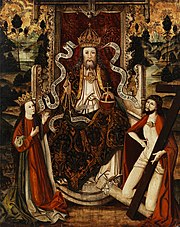
God the Father on a throne, Westphalia, Germany, late 15th century.
In that location are inherent and key differences between Buddhism and Christianity, one significant element being that while Christianity is at its core monotheistic and relies on a God as a Creator, Buddhism is mostly non-theistic and rejects the notion of a Creator God which provides divine values for the world.[3]
The Nicene Creed, currently the near widely used Christian creed, states that "We believe in ane God, the Male parent Omnipotent, Maker of sky and world, and of all things visible and invisible".[four] Withal, the notion of theistic creation is generally foreign to Buddhist idea, and the question of the existence of God is perhaps one of the almost fundamental barriers between the teachings of Christianity and Buddhism.[3] [v] Although Mahayana Buddhism expresses belief in the saint-like state of a Bodhisattva, this is very dissimilar from the notion of Creator God in Christianity.[5] [29] While some variations of Buddhism believe in an impersonal eternal Buddha or trikaya, in general Buddhism sees empty space as eternal and without a starting betoken of creation.[30] [31] According to the Dalai Lama, belief in a Creator could be associated with the agreement of emptiness, just "once a sure degree of realization has been reached, a choice betwixt the two paths volition become necessary."[32]
According to the Oxford Handbook of Eschatology, in that location are inherent differences in the Christian and Buddhist beliefs regarding the Terminate Times and eschatology.[33] Jan Nattier states that while Buddhism has a notion of "relative eschatology" that refers to specific cycles of life, the term "Buddhist eschatology" does not relate to whatsoever "last things", or that the world will cease i day – Buddhist scripture routinely referring to the "beginningless Saṃsāra" equally a never ending bike of nascence and death with no starting point.[34] Even so, Christian eschatology directly involves the concept of "stop to all creation" at the Last Judgement when the earth volition reach its decision.[35]
There are other fundamental incompatibilities, e.g. while grace is office of the very textile of Christian theology, in Theravada Buddhism no deity can interfere with karma, and hence the notion of any type of grace is inadmissible within these teachings.[29] Mahayana Buddhism nevertheless, differs on this issue.[36]
The crucifixion of Jesus as a single event in history that acts for the atonement of sins is a central element of Christian conventionalities.[11] This, nonetheless, produces a strong divergence betwixt Christian and Buddhist teachings.[11] [37] Buddhist scholar Masao Abe pointed out that while "the event of the Cross" is central to Christianity, it is not possible for Buddhism to accept its importance.[37] Buddhist philosopher D. T. Suzuki stated that every time he saw a crucifixion scene it reminded him of the "gap that lies deep" between Christianity and Buddhism.[38]
Buddhist influence on Christianity [edit]
Suggestions of influences [edit]

Suggestions accept been made that Buddhism may take influenced early Christianity.[1] Buddhist missionaries, sent by Emperor Ashoka of Bharat to Sri Lanka, Syrian arab republic, Egypt and Hellenic republic, may have helped ready for the ideals of Christ.[ii] [39] Gnostics (a modest number of sects) are not considered part of mainstream Christianity and some have been declared heretical. All the same, Elaine Pagels proposes Buddhist influences on Gnosticism. Pagels suggested that there are parallels with teachings attributed to Jesus Christ and teachings plant in Eastern traditions, but concludes that these parallels might be casual, since parallel traditions may emerge in unlike cultures without straight influence.[40]
Buddhist Jack Maguire has suggested that in the 4th century, Christian monasticism developed in Egypt, and it emerged with a respective structure comparable to the Buddhist monasticism of its fourth dimension and place.[39] In Alexandria, Indian gravestones dating from the Ptolemaic period (c. 305 BC – xxx BC) have been discovered in Alexandria.[41] Alexandria served as the Ptolemaic trading centre betwixt the Mediterranean Sea and the Indian subcontinent,[42] after encompassing "some of the most active centers of Christianity" and becoming the 3rd-most important seat of Christianity in the world.[43]
After studying Eastern philosophy, High german philosopher Arthur Schopenhauer states that "[the] New Testament must be of Indian origin [...] Everything true in Christianity is also to be discovered in Brahmanism and Buddhism," theorizing that after flight into Egypt, Jesus was "brought upward by Egyptian priests, whose religion was of Indian origin." Schopenhauer elaborates:
[When] this Indian doctrine entered into the Promised Land there arose the task of uniting the knowledge of the abuse and misery of the globe, of its demand for redemption and of salvation through an avatar, together with the morality of self-deprival and atonement, with Jewish monotheism and its 'Behold, it was very good'.[44]
The suggestion that an adult Jesus traveled to India and was influenced by Buddhism before starting his ministry in Galilee was first made by Nicolas Notovitch in 1894 in the book The Unknown Life of Jesus Christ which was widely disseminated and became the ground of other theories.[45] [46] Notovitch's theory was controversial from the kickoff and was widely criticized.[47] [48] One time his story had been re-examined past historians, Notovitch confessed to having fabricated the show.[48] [49]
Rejection of influences [edit]
A number of scholars have stated that suggestions of an influence from Buddhism on Christianity, particularly Jesus's alleged travels to Buddhist India, are fanciful and without whatsoever historical basis:
- Robert Van Voorst states that modern Christian scholarship has "most unanimously agreed" that claims of the travels of Jesus to Tibet, Kashmir or Bharat contain "nothing of value".[6]
- Marcus Borg states "Scholars have pointed out that Buddhist teachers lived in Alexandria, on the Mediterranean declension, by the first century. Some have posited that Jesus might have traveled there, or that Buddhist teachings may have reached cities of the Jewish homeland, including Sepphoris, a major city in Galilee only four miles from Nazareth. Popular speculation speaks of Jesus having traveled to India during "the missing years", the decades before he emerged on the phase of history. In that location, information technology is suggested, he came in to contact with Buddhist teachings. Merely both explanations are unlikely and unnecessary. The similarities are not of the kind that suggest cultural borrowing".[50]
- Leslie Houlden states that although modern parallels between the teachings of Jesus and Buddha have been drawn, these comparisons emerged after missionary contacts in the 19th century and at that place is no historically reliable evidence of contacts between Buddhism and Jesus.[7]
- Paula Fredriksen states that no serious scholarly piece of work places Jesus outside the properties of 1st century Palestinian Judaism.[17]
- Eddy and Boyd state that there is no evidence of a historical influence by outside sources on the authors of the New Attestation, and most scholars agree that any such historical influence on Christianity is entirely implausible given that offset century monotheistic Galilean Jews would not accept been open to what they would accept seen every bit pagan stories.[9] [18]
Christian influence on Buddhism [edit]
Christian influence on Buddhism in the 18th and 19th centuries was primarily past case of mod forms of religious teaching.[51] [52] During the last centuries, Christian missionaries take influenced many Buddhist groups such as the Buddhist nun Cheng Yen who, later on beingness inspired past the humanitarian aid done by Catholic nuns, decided that Buddhists need "to do more simply encourage the private tillage of people'southward souls". Her works somewhen led to the foundation of Tzu Chi, a not-profit humanitarian group in Asia.[53]
Contemporary Buddhist–Christian exchange [edit]
"Ask and it shall be given, seek and ye shall find, knock and it shall be opened unto you. For everyone that asketh receiveth, and he that seeketh findeth, and to him that knocketh, it shall exist opened."
Gasan remarked: "That is excellent. Whoever said that is not far from Buddhahood."
Paul Reps, Zen Flesh, Zen Bones
Attempts at convergence [edit]
Buddhism has been gaining popularity in the west. Starting with a cultural and academic elite in the 19th century, it is now widespread in western culture, especially since the 1960s.[54]
In the 20th century Christian monastics such as Thomas Merton, Wayne Teasdale, David Steindl-Rast and the former nun Karen Armstrong, and Buddhist monastics such as Ajahn Buddhadasa, Thich Nhat Hanh and the Dalai Lama have taken part in an interfaith dialogue most Buddhism and Christianity.[55] [56] This dialogue aims to shed light on the common ground between Buddhism and Christianity.[57] [58] [59]
Although the prevalent romantic view on Buddhism sees it as an accurate and ancient practice, gimmicky Buddhism is deeply influenced past the western culture. With the rise of western colonialism in the 19th century, Asian cultures and religions developed strategies to conform to the western hegemony, without losing their own traditions. Western discourses were taken over, and western polemic styles were applied to defend indigenous traditions.[54]
Rejection of convergence [edit]
In 1989 the Catholic Church, through the Congregation for the Doctrine of the Religion, rejected attempts at mixing some aspects of Christian and Buddhist practices, in a letter titled "Letter to the Bishops of the Cosmic Church on some aspects of Christian meditation", generally known as the Aspects of Christian meditation letter.[60] [61] [62]
The document issues warnings on differences and potential incompatibilities between Christian meditation and the styles of meditation used in eastern religions such equally Buddhism.[63] [64] Referring to some elements of Buddhism as "negative theology" the document states:
Still others do not hesitate to place that accented without prototype or concepts, which is proper to Buddhist theory, on the aforementioned level as the majesty of God revealed in Christ, which towers higher up finite reality. To this end, they make use of a "negative theology", which ... denies that the things of this earth tin offer traces of the infinity of God.[62]
Similar warnings were issued in 2003 in A Christian reflection on the New Age which too referred to Buddhism.[65] [66] The Southern Baptist Convention expressed agreement with those views.[67]
See likewise [edit]
- Barlaam and Josaphat
- Buddhism and Western Philosophy
- Buddhism in the West
- Buddhist influences on Christianity
- Buddhist-Christian Studies (journal)
- Christianity in Asia
- Alphabetize of Buddhism-related manufactures
- Jingjiao Documents
- List of converts to Buddhism from Christianity
- Nestorian Stele
- Parallelomania
- Persecution of Buddhists by Christians
- Secular Buddhism
References [edit]
- ^ a b Bentley, Jerry H. (1993). Old World Encounters. Cantankerous-cultural contacts and exchanges in pre-modern times. Oxford University Press. ISBN0-19-507639-seven.
- ^ a b Will Durant (7 June 2011). Our Oriental Heritage: The Story of Civilization. Simon and Schuster. pp. 711–. ISBN978-one-4516-4668-9 . Retrieved 27 August 2012.
- ^ a b c The Boundaries of Knowledge in Buddhism, Christianity, and Science by Paul D Numrich (Dec 31, 2008) ISBN 3525569874 page 10
- ^ a b International Standard Bible Encyclopedia: E-J by Geoffrey W. Bromiley (Mar 1982) ISBN 0802837824 pages 515-516
- ^ a b c Communicating Christ in the Buddhist World by Paul De Neui and David Lim (January i, 2006) ISBN 0878085106 page 34
- ^ a b Van Voorst, Robert Due east (2000). Jesus Outside the New Attestation: An Introduction to the Ancient Prove. Eerdmans Publishing. ISBN 0-8028-4368-9 page 17
- ^ a b Jesus: The Consummate Guide 2006 by Leslie Houlden ISBN 082648011X page 140
- ^ The Historical Jesus in Recent Enquiry edited by James D. M. Dunn and Scot McKnight 2006 ISBN ane-57506-100-7 folio 303
- ^ a b Gerald O'Collins, "The Subconscious Story of Jesus" New Blackfriars Volume 89, Result 1024, pages 710–714, November 2008
- ^ In the 13th century, international travelers, such as Giovanni de Piano Carpini and William of Ruysbroeck, sent back reports of Buddhism to the West and noted the similarities with Nestorian Christian communities.Macmillan Encyclopedia of Buddhism, 2004, page 160
- ^ a b c Jesus: The Complete Guide past J. L. Houlden (February eight, 2006) ISBN 082648011X pages 140-144
- ^ Will Durant, The Story of Civilization Part I (New York: Simon and Schuster, 1935), vol. 1, p. 449.
- ^ Co-ordinate to the linguist Zacharias P. Thundy
- ^ a b Living Zen by Robert Linssen (Grove Press New York, 1958) ISBN 0-8021-3136-0
- ^ "The Original Jesus" (Element Books, Shaftesbury, 1995), Elmar R Gruber, Holger Kersten
- ^ The Greeks in Bactria and India, West.W. Tarn, South Asia Books, ISBN 81-215-0220-9
- ^ a b Fredriksen, Paula. From Jesus to Christ. Yale University Press, 2000, p. xxvi.
- ^ a b The Jesus legend: a case for the historical reliability of the synoptic gospels by Paul R. Eddy, Gregory A. Boyd 2007 ISBN 0-8010-3114-1 folio 53-54
- ^ a b Bentley, Jerry H. (1992). Cantankerous-Cultural Contacts and Exchanges in Pre-Modern Times. Oxford University Printing. p. 240. ISBN978-0-19-507640-0.
- ^ McEvilley, p391
- ^ Cloudless of Alexandria Stromata. BkI, Ch Fifteen http://www.ccel.org/ccel/schaff/anf02.vi.iv.i.fifteen.html (Accessed 19 Dec 2012)
- ^ Indian Buddhism: A Survey with Bibliographical Notes by Hajime Nakamura (Apr 11, 2007) ISBN 8120802721 folio 95
- ^ a b c d Macmillan Encyclopedia of Buddhism, 2004, page 160
- ^ Encyclopædia Britannica, viii edition, commodity Buddhism past T.W. Rhys Davids
- ^ De Bunsen, Ernest (1880). The Angel-Messiah of Buddhists, Essenes, and Christians. Longmans, Green, and Company. p. fifty.
- ^ Beverley, James A., "Hollywood's Idol", Christianity Today June eleven 2001, Vol. 45, No. 8. Retrieved April 20, 2007.
- ^ Kim, Bokin. "Christ as the Truth, the Low-cal, the Life, merely a Mode?" Buddhist-Christian Studies, vol. xix, 1999, pp. 76-80. Project MUSE, doi:10.1353/bcs.1999.0023
- ^ Tsomo, Lama; Fox, Matthew (2018). The Lotus & The Rose. ISBN978-0999577004.
- ^ a b Encyclopedia of Reincarnation and Karma past Norman C. McClelland (Apr ane, 2010) ISBN 0786448512 page 149
- ^ Guang Xing, The Concept of the Buddha, RoutledgeCurzon, London, 2005, p. 89
- ^ Hattori, Sho-on (2001). A Raft from the Other Shore : Honen and the Way of Pure State Buddhism. Jodo Shu Press. pp. 25–27. ISBNfour-88363-329-ii.
- ^ "Dalai Lama Answers Questions on Various Topics".
- ^ The Oxford Handbook of Eschatology by Jerry L. Walls (Apr 16, 2010) ISBN 0199735883 page 552
- ^ The Oxford Handbook of Eschatology by Jerry L. Walls (Apr 16, 2010) ISBN 0199735883 page 151
- ^ The Oxford Companion to Christian Thought by Adrian Hastings, Alistair Mason and Hugh Pyper (Dec 21, 2000) ISBN 0198600240 folio 206
- ^ Richard Yard. Payne (ed.), Tantric Buddhism in Eastern asia, Wisdom Publications, ISBN 0861714873, 2006, p. 74
- ^ a b Buddhism and Interfaith Dialogue past Masao Abe and Steven Heine (Jun 1, 1995) ISBN pages 99-100
- ^ Mysticism, Christian and Buddhist by Daisetz Teitaro Suzuki ((Aug 4, 2002)) ISBN 1605061328 page 113
- ^ a b Maguire, Jack (2001). Essential Buddhism. Simon and Schuster. pp. 159–160. ISBN0-671-04188-6.
- ^ Pagels, Elaine (1979). The Gnostic Gospels. New York: Random House, repr. 1989.
- ^ Tarn. The Greeks in Bactria and India. p. 370.
- ^ Lindsay, W South (2006). History of Merchant Shipping and Ancient Commerce. Determined Media Corporation. ISBN0-543-94253-8.
- ^ Linssen; Robert (1958). Living Zen. London: Allen & Unwin. p. 208.
- ^ Arthur Schopenhauer (2004). Essays and Aphorisms. Penguin Classics. pp. 190–191. ISBN978-0-14-044227-4.
- ^ The Unknown Life Of Jesus Christ: Past The Discoverer Of The Manuscript by Nicolas Notovitch (October 15, 2007) ISBN 1434812839
- ^ Forged: Writing in the Name of God--Why the Bible's Authors Are Not Who We Think They Are by Bart D. Ehrman (Mar 6, 2012) ISBN 0062012622 folio 252 "one of the most widely disseminated modern forgeries is called The Unknown Life of Jesus Christ"
- ^ Simon J. Joseph, "Jesus in India?" Journal of the American Academy of Organized religion Volume fourscore, Outcome ane pp. 161-199 "Max Müller suggested that either the Hemis monks had deceived Notovitch or that Notovitch himself was the writer of these passages"
- ^ a b New Testament Apocrypha, Vol. 1: Gospels and Related Writings by Wilhelm Schneemelcher and R. Mcl. Wilson (December 1, 1990) ISBN 066422721X page 84 "a item book by Nicolas Notovich (Di Lucke im Leben Jesus 1894) ... presently later the publication of the book, the reports of travel experiences were already unmasked as lies. The fantasies most Jesus in India were also soon recognized as invention... down to today, nobody has had a glimpse of the manuscripts with the declared narratives almost Jesus"
- ^ Indology, Indomania, and Orientalism by Douglas T. McGetchin (Jan 1, 2010) Fairleigh Dickinson University Printing ISBN 083864208X folio 133 "Faced with this cross-examination, Notovich confessed to fabricating his bear witness."
- ^ Borg, Thou., Jesus & Buddha: The parallel sayings, Ulysses Press, 2004, p.ten
- ^ Theravāda Buddhism: A Social History from Ancient Benares to ... - Page 130 Richard Francis Gombrich - 2006 "The main Christian influence on Buddhists was by reaction. The missionaries propagated Christianity in iii main ways: by education, preaching, and pamphleteering. Every mission station had a primary schoolhouse, and the Church of England ..."
- ^ David L. McMahan The Making of Buddhist Modernism - Page 7 Acquaintance Professor of Religious Studies Franklin & Marshall College - 2008 "Richard Gombrich and Gananath Obeyesekere have mapped similar trends specifically in Sinhalese Buddhism in Sri Lanka. Emphasizing the Christian influence on modernizing forms of Sinhalese Buddhism in the tardily nineteenth and ..."
- ^ "Biography of Dharma Master Cheng Yen". Buddhist Compassion Relief Tzu Chi Foundation. 22 May 2014.
- ^ a b McMahan 2008. sfn fault: no target: CITEREFMcMahan2008 (help)
- ^ Westward.Fifty. King, Buddhism and Christianity: Some Bridges of Agreement, Philadelphia, 1963.
- ^ Armstrong on Buddhism & Christianity
- ^ Tinker, Hugh (1966). S Asia: A Short History . Frederick A. Praeger. p. 83.
- ^ The Dalai Lama,The Good Heart: A Buddhist Perspective on the Teachings of Jesus, ISBN 0-86171-138-6
- ^ Thich Nhat Hahn, Going Home: Jesus and Buddha as Brothers, 1999. ISBN 1-57322-830-iii
- ^ Acta Apostolicae Sedis 82 (1990) 362-379
- ^ Letter on sure aspects of the Christian meditation on the Vatican Certificate Index
- ^ a b Vatican website: LETTER TO THE BISHOPS OF THE CATHOLIC CHURCH ON SOME ASPECTS OF CHRISTIAN MEDITATION October 15, 1989
- ^ Letter to the Bishops of the Catholic Church on some aspects of Christian meditation on EWTN
- ^ The coming together of religions and the Trinity by Gavin D'Costa 2000 ISBN 0-567-08730-i page 152
- ^ Handbook of vocational psychology by Due west. Bruce Walsh, Mark Savickas 2005 ISBN 0-8058-4517-8 page 358
- ^ Vatican website A Christian reflection on the New Age Archived Oct 1, 2013, at the Wayback Automobile
- ^ "Los Angeles Times, February 8, 2003 New Age Beliefs Aren't Christian, Vatican Finds". Los Angeles Times. Archived from the original on July ane, 2012. Retrieved December fifteen, 2012.
Source: https://en.wikipedia.org/wiki/Buddhism_and_Christianity
0 Response to "Is Buddha Born Again as Jesus"
Post a Comment